
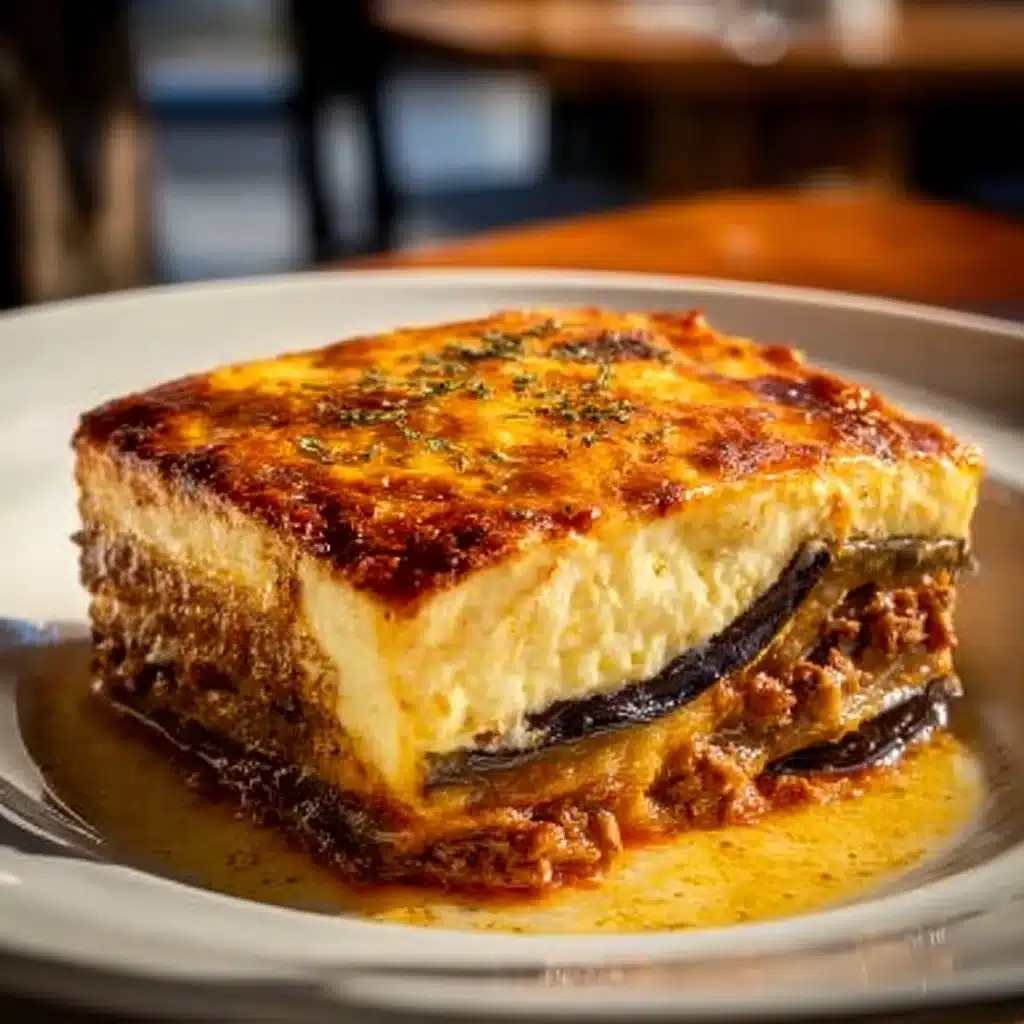
Greek Moussaka arrives at the table with layered refinement: silky béchamel, spiced lamb ragù, and tender roasted eggplant. This classic Greek Moussaka showcases balanced textures and a restrained spice profile, making it both comforting and sophisticated. Serve it beside a crisp green salad or a lighter starter such as Avocado Toast Delight to create a composed Mediterranean menu.
Why Make This Recipe
- Effortless Yet Elegant — familiar techniques (roasting, simmering, baking) yield a restaurant-quality finish.
- Minimal Ingredients — pantry staples combine to deliver complex flavor without fuss.
- Impressive Flavor — warm spices, bright tomato, and a glossy béchamel create layered taste and texture.
This version elevates ordinary moussaka by roasting eggplant for concentrated sweetness, slow-simmering the ragù to deepen flavor, and finishing with a lightly nutmeg-scented béchamel for a silky, golden top.
Ingredients
Base
- 2 large eggplants, sliced 1/2-inch thick (salted and drained)
- 2 medium potatoes, peeled and sliced 1/4-inch (optional for a firmer base)
- Olive oil for brushing and roasting (use extra-virgin for finishing)
Ragù (meat sauce)
- 1 lb (450 g) ground lamb (or beef) — room temperature
- 1 large onion, finely chopped
- 3 garlic cloves, minced
- 1/2 cup dry red wine (or stock) — for deglazing
- 1 can (14 oz) crushed tomatoes
- 1 tbsp tomato paste
- 1 tsp ground cinnamon, 1 tsp dried oregano, bay leaf
- Salt and freshly ground black pepper to taste
Béchamel topping
- 4 tbsp unsalted butter — room temperature
- 4 tbsp all-purpose flour
- 3 cups whole milk, warmed
- 2 large egg yolks, lightly beaten (tempered into sauce)
- Pinch of freshly grated nutmeg, salt, and white pepper
- 1/2 cup grated Parmesan or Kefalotyri — finely grated
Garnish
- Fresh parsley, finely chopped
Precision notes: finely chop fresh herbs; warm milk before whisking to avoid lumps; grate cheese finely for even melting.
How to Make Greek Moussaka:
- Prepare the eggplant and potatoes. Salt eggplant slices lightly and let them sweat 20–30 minutes; rinse and pat dry. Brush both eggplant and potato slices with olive oil and roast at 425°F (220°C) until edges caramelize and flesh becomes tender and slightly golden (about 20–25 minutes). (Mini-tip: roast on a wire rack for crisp edges.)
- Make the ragù. Heat a splash of oil in a heavy skillet over medium-high heat. Add onions and cook until translucent and fragrant. Add garlic, then the ground lamb; brown thoroughly, breaking up any clumps. (Mini-tip: do not crowd the pan — good browning develops flavor.)
- Deglaze the pan with red wine, scraping browned bits to capture all flavor. Stir in tomato paste, crushed tomatoes, cinnamon, oregano, and bay leaf. Reduce heat and simmer gently until the sauce thickens and flavors concentrate, 25–35 minutes. Season to taste. (Sensory cue: the ragù should smell warmly spiced and appear glossy and slightly reduced.)
- Make the béchamel. Melt butter in a saucepan over medium heat. Whisk in flour and cook briefly until a pale roux forms (1–2 minutes). Gradually whisk in warm milk, smoothing lumps, until the sauce thickens to a velvety, ribbon-like consistency. Remove from heat, whisk in egg yolks slowly to enrich, then stir in nutmeg, salt, white pepper, and most of the grated cheese. (Mini-tip: temper the yolks with a ladle of béchamel to prevent curdling.)
- Assemble. In a buttered baking dish, layer potatoes (if using), then a single layer of roasted eggplant, half the ragù, another eggplant layer, the remaining ragù, and finish with the béchamel spread evenly. Sprinkle remaining cheese on top. (Mini-tip: smooth the béchamel so the surface bakes to a uniform golden crust.)
- Bake at 375°F (190°C) until the top is deeply golden and bubbling, about 35–45 minutes. Let the moussaka rest 20–30 minutes before slicing to set layers. (Sensory cue: a knife should glide through a set, silky center; aroma will be savory with cinnamon and tomato notes.)
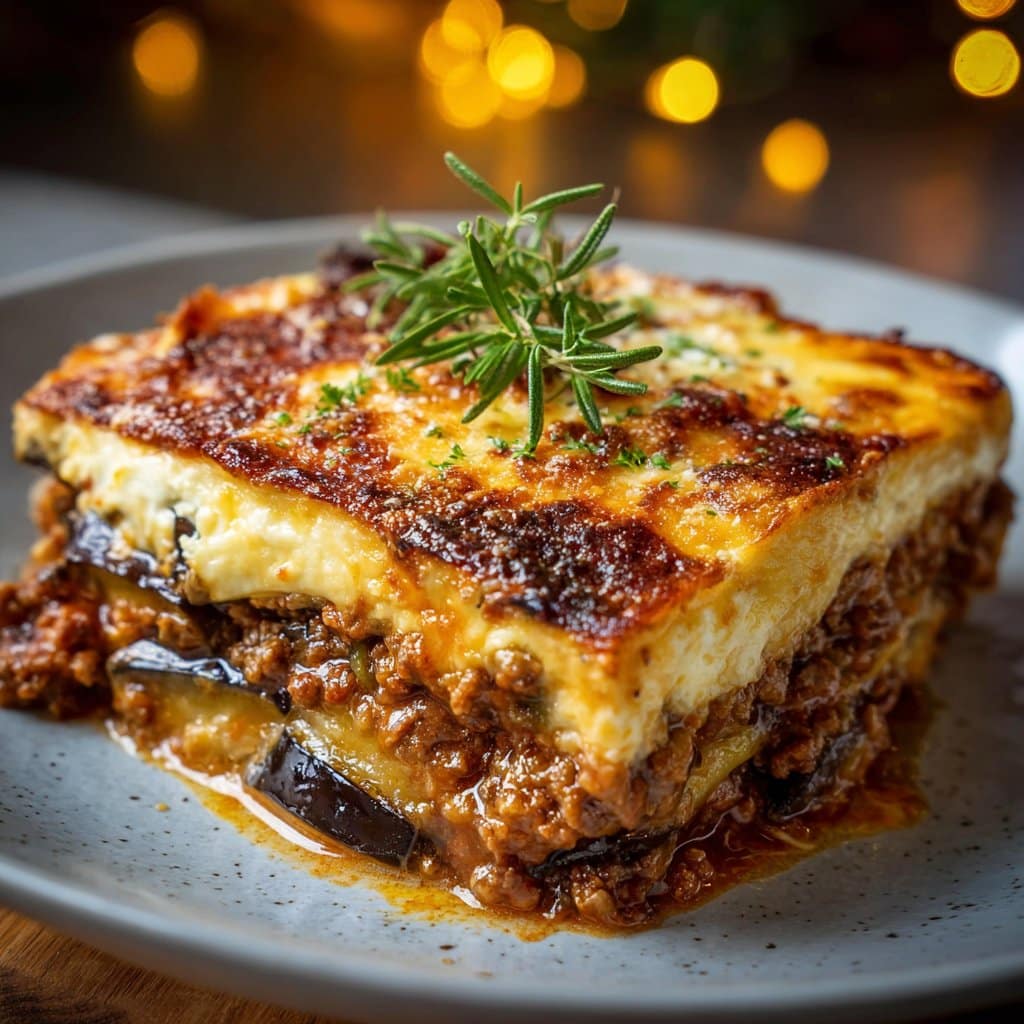
How to Serve Greek Moussaka
Slice into generous squares and plate on warmed dishes. For an elegant presentation, top each portion with a dusting of chopped parsley and a few microgreens for brightness. Serve alongside a crisp Greek salad, lemon wedges, and a delicate starter such as Crab Brûlée to contrast richness with fresh acidity.
How to Store Greek Moussaka
Cool completely before covering to prevent condensation. Refrigerate in an airtight container for up to 3 days. For longer storage, freeze in portions; wrap tightly with plastic and foil for up to 2 months. To reheat, thaw overnight if frozen, then bake covered at 325°F (160°C) until warmed through; uncover for the last 10 minutes to revive the golden top. Avoid microwaving if you want to preserve the béchamel’s silky texture and a crisped surface.
Tips to Make Greek Moussaka
- Salt and drain eggplant to remove bitterness and reduce oil absorption.
- Roast rather than fry eggplant for a cleaner flavor and less grease.
- Let the assembled moussaka rest before slicing to set the layers and improve presentation.
- Use whole milk and a patient roux for a béchamel that is smooth and stable.
- Brown the meat well — those fond bits are essential for a deep, savory ragù.
Variation
- Lamb vs. beef: Lamb gives a traditional, robust profile; beef makes a milder ragù.
- Vegetarian: Replace meat with cooked lentils or spiced mushrooms, and enrich béchamel with a touch of cream.
- Cheese upgrade: Fold grated Kefalotyri or aged Manchego into the béchamel for a sharper finish.
- Mini-portions: Bake moussaka in individual ramekins for refined single servings.
Is moussaka gluten-free?
Traditional moussaka uses flour in the béchamel, so it is not gluten-free. Use a gluten-free flour blend or cornstarch as a roux alternative to adapt the sauce.
Can I make this ahead of time?
Yes. Assemble and refrigerate for up to 24 hours before baking, or fully bake, cool, and refrigerate—reheat in the oven. The flavors often deepen when made a day ahead.
How do I prevent soggy eggplant?
Salt slices and let them sit to draw out moisture, then rinse and pat dry. Roast until caramelized rather than frying straight from raw slices.
What is the best cheese to use in the béchamel?
A hard, salty cheese like Parmesan or Kefalotyri works beautifully; grate finely so it melts uniformly into the sauce.
Conclusion
Greek Moussaka offers a composed balance of textures: silky béchamel, lush ragù, and tender roasted vegetables. It reads as sophisticated yet remains accessible — the kind of dish that rewards patience with a deep, aromatic finish. Share your plating ideas and any tweaks in the comments, and tag photos to inspire others. For a classic Mediterranean dessert pairing, consider serving baklava from Best Baklava in Kenosha, WI | Gyro Grill. How would you make this dish your own?
Print
Greek Moussaka
- Total Time: 90 minutes
- Yield: 6 servings 1x
- Diet: Omnivore
Description
A classic Greek dish layered with silky béchamel, spiced lamb ragù, and tender roasted eggplant, combining comfort and sophistication.
Ingredients
- 2 large eggplants, sliced 1/2-inch thick (salted and drained)
- 2 medium potatoes, peeled and sliced 1/4-inch (optional for a firmer base)
- Olive oil for brushing and roasting (use extra-virgin for finishing)
- 1 lb (450 g) ground lamb (or beef)
- 1 large onion, finely chopped
- 3 garlic cloves, minced
- 1/2 cup dry red wine (or stock)
- 1 can (14 oz) crushed tomatoes
- 1 tbsp tomato paste
- 1 tsp ground cinnamon
- 1 tsp dried oregano
- 1 bay leaf
- Salt and freshly ground black pepper to taste
- 4 tbsp unsalted butter
- 4 tbsp all-purpose flour
- 3 cups whole milk, warmed
- 2 large egg yolks, lightly beaten
- Pinch of freshly grated nutmeg, salt, and white pepper
- 1/2 cup grated Parmesan or Kefalotyri, finely grated
- Fresh parsley, finely chopped (for garnish)
Instructions
- Salt eggplant slices lightly and let them sweat for 20–30 minutes; rinse and pat dry.
- Brush both eggplant and potato slices with olive oil and roast at 425°F (220°C) until edges caramelize and flesh becomes tender and slightly golden (about 20–25 minutes).
- In a heavy skillet over medium-high heat, heat a splash of oil. Add onions and cook until translucent.
- Add garlic, then ground lamb; brown thoroughly, breaking up any clumps.
- Deglaze pan with red wine, scraping browned bits. Stir in tomato paste, crushed tomatoes, cinnamon, oregano, and bay leaf. Reduce heat and simmer for 25–35 minutes, until thickened and flavors concentrate. Season to taste.
- Melt butter in a saucepan over medium heat and whisk in flour, cooking until a pale roux forms (1–2 minutes).
- Gradually whisk in warm milk, smoothing lumps, until the sauce thickens to a velvety consistency. Remove from heat and whisk in egg yolks, nutmeg, salt, white pepper, and most of the grated cheese.
- In a buttered baking dish, layer potatoes (if using), a layer of roasted eggplant, half the ragù, another eggplant layer, remaining ragù, and finish with the béchamel spread evenly. Sprinkle remaining cheese on top.
- Bake at 375°F (190°C) until the top is deeply golden and bubbling, about 35–45 minutes. Let it rest for 20–30 minutes before slicing.
Notes
Let the assembled moussaka rest before slicing to set the layers and improve presentation. Store leftovers in an airtight container for up to 3 days or freeze for up to 2 months.
- Prep Time: 30 minutes
- Cook Time: 60 minutes
- Category: Main Course
- Method: Baking
- Cuisine: Greek
Nutrition
- Serving Size: 1 serving
- Calories: 450
- Sugar: 6g
- Sodium: 600mg
- Fat: 20g
- Saturated Fat: 8g
- Unsaturated Fat: 10g
- Trans Fat: 0g
- Carbohydrates: 30g
- Fiber: 5g
- Protein: 25g
- Cholesterol: 100mg