
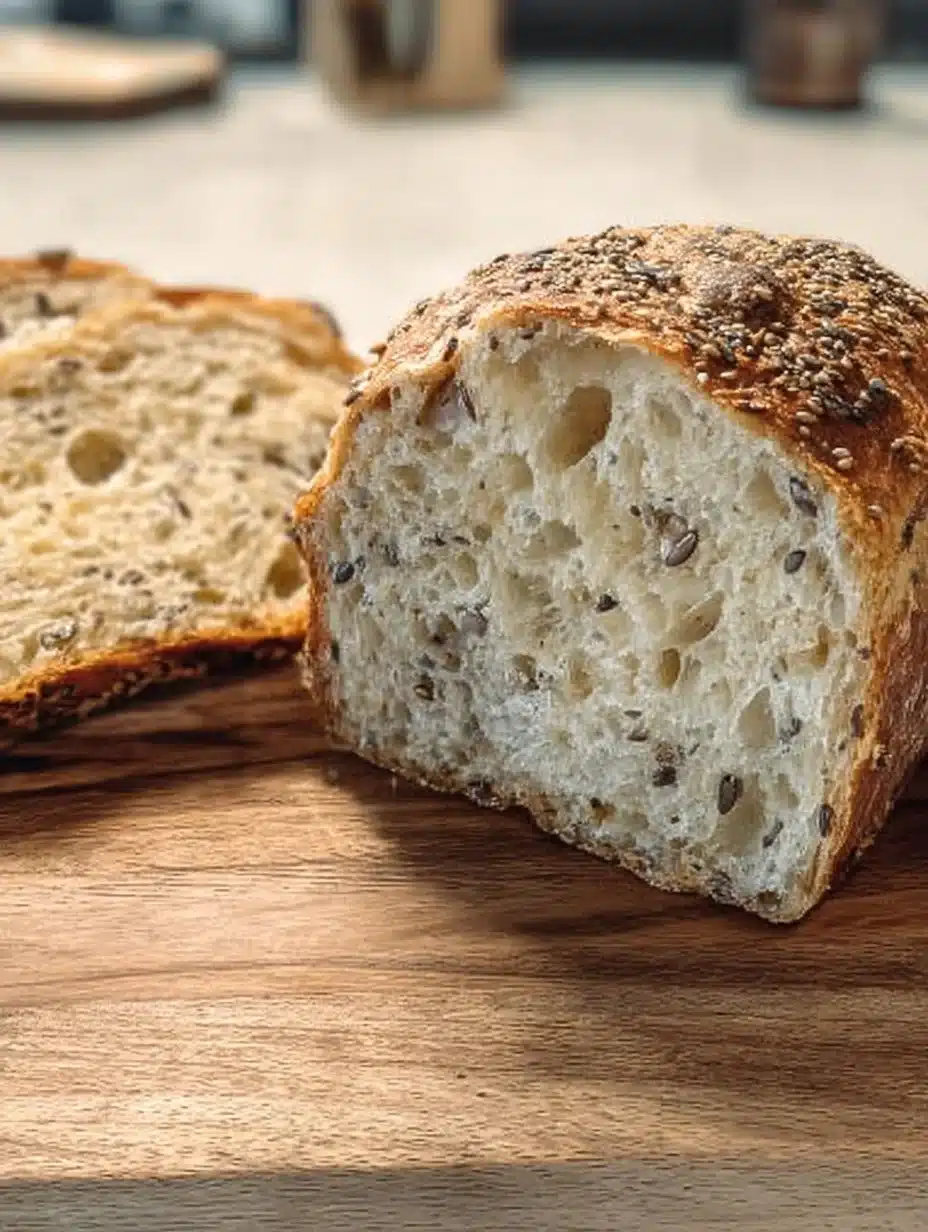
Sourdough Seeded Sandwich Bread arrives at the table with a bronzed crust, a tender crumb, and a nuanced nutty aroma. This loaf refines the everyday sandwich bread by folding in a medley of toasted seeds and a lively starter for depth of flavor. For a broader take on classic loaves, consult our classic sandwich bread guide to compare techniques and shaping options.
Why Make This Recipe
- Effortless Yet Elegant: straightforward steps yield a loaf worthy of a special breakfast or a refined picnic.
- Minimal Ingredients: pantry staples plus a few seeds deliver complex taste without fuss.
- Impressive Flavor: the sourdough starter and toasted seeds add a gentle tang and toasted crunch.
What elevates this version is the balance of a soft, pillowy crumb against a crisp, seed-speckled crust. The result reads as both rustic and polished—an artisanal loaf that complements delicate fillings and bold cheeses alike.
Ingredients
Base
- 450 g (3 1/2 cups) bread flour — for strength and a fine crumb.
- 50 g (1/2 cup) whole wheat flour — adds depth and color.
- 330–360 g (1 1/3–1 1/2 cups) water, lukewarm — adjust for dough feel.
- 150 g active sourdough starter (100% hydration), fed and bubbly — mature starter for lift.
- 10 g (2 tsp) fine sea salt.
- 20 g (1 1/2 tbsp) honey or maple syrup — for gentle sweetness.
- 25 g (2 tbsp) unsalted butter, softened to room temperature.
Seed mix
- 40 g (1/3 cup) sunflower seeds, toasted — deep, nutty flavor.
- 30 g (3 tbsp) pumpkin seeds, toasted — firm texture.
- 20 g (2 tbsp) flax seeds — slightly crunchy, earthy.
- 15 g (1 tbsp) sesame seeds — delicate aroma.
- Note: Toast seeds in a dry pan until fragrant and lightly browned; cool before mixing.
Topping & finishing
- 1 egg, beaten, or milk for wash — creates sheen and helps seeds adhere.
- Extra mixed seeds for sprinkling.
- Optional: 1 tsp flaky sea salt for the crust.
For more sourdough techniques beyond bread loaves, explore our sourdough recipe collection.
How to Make Sourdough Seeded Sandwich Bread
- Prepare the starter and seeds. Ensure your starter is active and bubbly (peaks within 4–8 hours of feeding). Toast the seeds in a dry skillet until they emit a warm, nutty scent and are lightly browned; let cool.
- Mini-tip: Toast seeds in batches to avoid steaming; cool on a tray for crispness.
- Autolyse. In a large bowl, mix flours and 330 g lukewarm water until no dry flour remains. Rest 30–45 minutes until the dough feels soft and slightly stretchy.
- Sensory cue: the dough will become satin-smooth and slightly tacky.
- Add starter, honey, and salt. Incorporate the starter, honey, and room-temperature butter into the autolysed dough. Knead lightly by hand or with a mixer on low until the dough becomes elastic (about 6–8 minutes).
- Mini-tip: If dough feels tight, add up to 30 g more water in small increments.
- Bulk fermentation with folds. Transfer dough to a lightly oiled container. Perform a set of stretch-and-folds every 30 minutes for the first 2 hours (4 sets total). Let rest until roughly doubled in volume—about 3–4 hours total depending on temperature.
- Sensory cue: the dough will hold gentle dimples and smell tangy and yeasty.
- Incorporate seeds. Flatten the dough gently, scatter the cooled toasted seeds across the surface, fold to enclose, then perform two gentle turns to distribute seeds evenly without crushing them.
- Shape and proof. Pre-shape into a loaf, bench rest 15 minutes, then shape tightly to fit a 9×5-inch (23×13 cm) loaf pan. Place seam-side down. Brush with beaten egg or milk and sprinkle with remaining seeds. Cover and proof until the dough rises just above the pan rim (about 1–2 hours).
- Mini-tip: A slightly underproofed loaf will yield a finer, chewier crumb while an overproofed one may collapse.
- Bake. Preheat the oven to 220°C (425°F). Bake 10 minutes at 220°C, then reduce to 190°C (375°F) and bake 25–30 minutes more until crust is deep golden and an internal temperature reads 96°C (205°F).
- Sensory cue: the crust should crackle slightly and the aroma should be toasty and wheaty.
- Mini-tip: Tent foil if the seeds brown too quickly.
- Cool. Remove from pan and cool on a rack at least 1 hour before slicing to set the crumb.
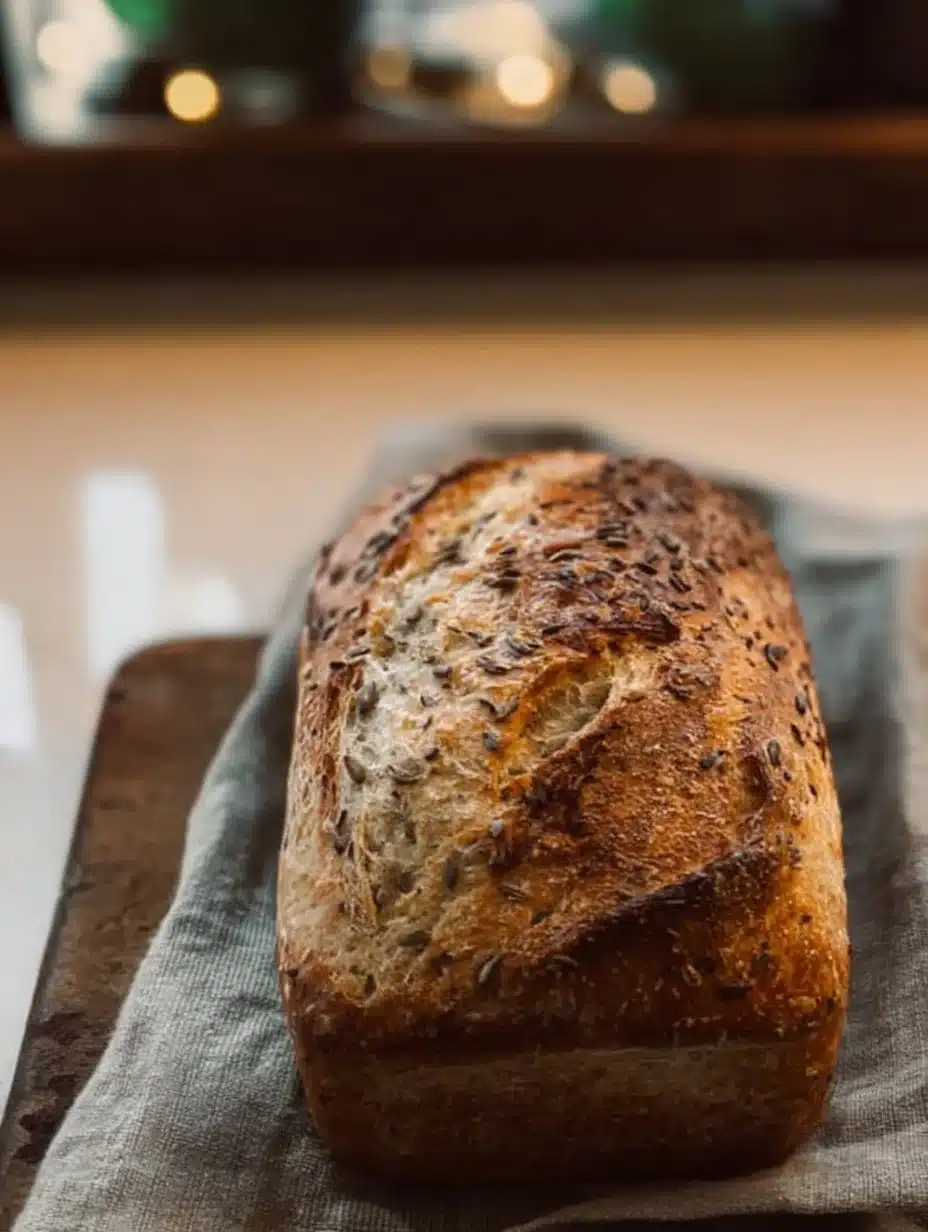
How to Serve Sourdough Seeded Sandwich Bread
Slice thick for open-faced compositions topped with whipped goat cheese, thinly sliced pears, and microgreens. For sandwiches, pair with smoked turkey, watercress, and a smear of grainy mustard to echo the bread’s texture. For a simple, refined snack, warm a slice, spread cultured butter, and sprinkle a pinch of flaky sea salt.
How to Store Sourdough Seeded Sandwich Bread
Cool completely before storing to prevent moisture buildup. For short-term storage, keep wrapped in a linen bag or a bread box at room temperature for 2–3 days to preserve crust texture. For longer life, slice and freeze in an airtight bag; toast from frozen or thaw at room temperature and refresh briefly in a 180°C (350°F) oven for crispness. Avoid refrigeration, which accelerates staling.
Tips to Make Sourdough Seeded Sandwich Bread
- Use a mature starter: feed 6–12 hours prior so it’s lively and buoyant for strong rise.
- Toast seeds first: it deepens flavor and keeps them from steaming inside the dough.
- Watch dough hydration: flour absorption varies by brand—aim for a slightly tacky, extensible dough.
- Gentle folding protects seed integrity while encouraging gluten strength.
- Cool fully before slicing to avoid gummy crumbs.
Variation (if any)
- Olive & Rosemary: swap herb-flecked olive oil for butter and fold in 2 tbsp chopped rosemary plus 50 g chopped olives.
- Nutty Upgrade: replace half the sunflower seeds with toasted chopped pecans for a richer bite.
- Lightweight White: use only bread flour and reduce whole wheat to 0 g for a softer, lighter crumb suitable for delicate fillings.
FAQs
How active should my starter be before using it?
Use a starter that has doubled and shows many small bubbles, with a pleasant tang and a dome that crests about 4–8 hours after feeding. It should float in water if you perform a float test.
Can I substitute all-purpose flour for bread flour?
You can, but expect a softer, less structured crumb. Bread flour gives better gluten development and a taller loaf; if using all-purpose, reduce water slightly and handle dough gently.
How do I prevent the seeds from sinking into the crumb?
Toast and cool seeds first, and incorporate them after initial bulk fermentation so the dough has structure. Fold seeds in gently to distribute without crushing.
Can I make this loaf in a freeform shape instead of a pan?
Yes—shape into a batard and bake on a preheated baking stone. Bake at the same temperatures but allow slightly longer time; watch for deep color and internal temperature.
Conclusion
Sourdough Seeded Sandwich Bread balances refined technique with everyday utility: a bronzed crust, a tender, seeded interior, and a layered, toasty aroma. The loaf stands beautifully beside delicate cheeses or as the foundation of elevated sandwiches—its seeded crunch and gentle sour note lift every bite. For another soft multigrain approach that complements this method, see the Soft Multigrain Sourdough Sandwich Bread recipe for additional inspiration. Share your variations and photos in the comments — how would you make this dish your own?
Print
Sourdough Seeded Sandwich Bread
- Total Time: 55 minutes
- Yield: One loaf (approximately 10 slices)
- Diet: Vegetarian
Description
A sophisticated take on sandwich bread with toasted seeds and a sourdough starter for added depth of flavor.
Ingredients
- 450 g (3 1/2 cups) bread flour
- 50 g (1/2 cup) whole wheat flour
- 330–360 g (1 1/3–1 1/2 cups) lukewarm water
- 150 g active sourdough starter (100% hydration), fed and bubbly
- 10 g (2 tsp) fine sea salt
- 20 g (1 1/2 tbsp) honey or maple syrup
- 25 g (2 tbsp) unsalted butter, softened
- 40 g (1/3 cup) sunflower seeds, toasted
- 30 g (3 tbsp) pumpkin seeds, toasted
- 20 g (2 tbsp) flax seeds
- 15 g (1 tbsp) sesame seeds
- 1 egg, beaten, or milk for wash
- Extra mixed seeds for sprinkling
- Optional: 1 tsp flaky sea salt for the crust
Instructions
- Prepare the starter and seeds by ensuring your starter is active and bubbly. Toast the seeds in a dry skillet until fragrant.
- Autolyse: In a large bowl, mix flours and 330 g lukewarm water until no dry flour remains. Rest for 30–45 minutes.
- Add starter, honey, and salt to the autolysed dough, then knead lightly until elastic.
- Transfer dough to a lightly oiled container. Perform stretch-and-folds every 30 minutes for the first 2 hours.
- Incorporate the cooled toasted seeds into the dough and fold gently.
- Pre-shape into a loaf, bench rest for 15 minutes, and then shape tightly for a loaf pan.
- Brush with egg or milk, sprinkle with seeds, and proof until dough rises just above the pan rim.
- Bake in a preheated oven at 220°C (425°F) for 10 minutes, then reduce to 190°C (375°F) and bake for an additional 25–30 minutes.
- Cool on a rack for at least 1 hour before slicing.
Notes
Slice thick for an array of sandwich options. Store wrapped at room temperature for a few days or freeze for longer shelf life.
- Prep Time: 15 minutes
- Cook Time: 40 minutes
- Category: Bread
- Method: Baking
- Cuisine: Artisanal
Nutrition
- Serving Size: 1 slice
- Calories: 200
- Sugar: 2g
- Sodium: 200mg
- Fat: 8g
- Saturated Fat: 3g
- Unsaturated Fat: 4g
- Trans Fat: 0g
- Carbohydrates: 30g
- Fiber: 3g
- Protein: 6g
- Cholesterol: 15mg